I Found a 1983 Receipt That Changed How I Think About Cloud Storage
One of the most common questions I get from people is “Mel, what free options are there for storing my digital photos? I’m not paying for storage!” And I get it — we have somehow come to expect that storage space for our photos or videos should be free. I think it’s because it’s intangible, especially “cloud” services that feel like you’re just renting air.
But I recently discovered a price list from a camera shop in 1983 that has changed my answer to that question from sympathy and understanding to “Suck it up, buttercup, because your photos aren’t free and they never were!”
If you’ve ever bought or built a home, you know you also have to pay for the land it sits on — either outright, or through a lease. (Don’t worry, this isn’t a real estate post!) You’re focused on the house itself, since that’s where your family memories get made. But it’s the land underneath that gives you the peace of mind that your home is safe and secure.
Your digital photos and videos need the same thing: a place that offers safety, security, and room to grow — not an afterthought. Treat it as an afterthought, and disaster is only a matter of time.
WHY DO WE RESIST PAYING FOR PHOTO STORAGE SOLUTIONS?
I have a few theories about why we expect photo storage to be free:
-
Big Tech treats photo storage like an afterthought: If you have a smartphone and turn on cloud syncing, then by default your phone’s photos are stored with one of the big tech companies – Apple or Google. These big global corporations have business models that are driven by priorities like selling us shiny new devices (Apple), or capturing our attention and data so they can sell it to advertisers (Google). You are given a small amount of storage space for free – basically just enough so your device operates as it should and you don’t throw it in the river. Start using your device on a more than a basic level and that storage quickly fills up with pics, messages, apps, and other data.
-
Photo Preservation Does Not Drive Revenue for Device Manufacturers: It’s pretty crazy how quickly we dropped our actual cameras the minute smartphones were introduced. Look, I’m guilty! I don’t even own a camera anymore and I love photos. I love the convenience of carrying just one device and being able to snap a quick pic in just a couple of swipes. But, the issue with this societal shift is that the Apple, Samsung, and other phone manufacturers know that camera features on a smartphone are a value-add for consumers, but they’re not a main driver of revenue for their shareholders. Every new device release has camera gimmicks that make us ooh and ahh, but there is still no financial incentive to give us a place to keep our thousands of photos. You gave them your money for the phone, and now the rest is your problem.
-
You Can’t Hold “The Cloud” in Your Hands: In fact, the term “the cloud” is probably the single biggest tech concept I’m asked about by my clients and students. It’s not a “cloud” at all – it’s a massive global maze of servers and equipment – but by calling it the cloud, tech companies make it seem as nebulous as air. And why should I pay Big Tech billionaires $2.99 a month for “air?”
-
Digital Storage is Hard to Quantify: Humans tend to place more value on things we can measure, and digital photos are hard to measure. If you are decluttering your house, you will be able to know how many trash bags you might need or what size storage unit will work. Since our digital photos are intangible, we can’t quantify them quite as easily.
SO, WHAT COULD GO WRONG?
As a digital photo organizer, I’ve seen the ‘I’m not paying for that’ mindset go sideways in heartbreaking ways. Here’s just a couple of examples.
-
I met Deborah while giving a presentation to a local community group. She approached me afterwards and told me about how she had ignored “iCloud Storage Full” notifications on her iphone for well over a year, not realizing that “full storage” meant her photos on her phone could no longer sync to her iCloud account. When she eventually got a new iPhone, she noticed that the past 19 months of photos didn’t sync to her new phone. And of course, her old phone had already been wiped and returned to her cell provider so those photos were gone forever and were unrecoverable. She lost photos and videos of her daughter’s bridal shower, wedding, and the last months they had with their family dog who they had lost the year before.
-
Jen, a client who came to me with more Google Photos accounts than she could remember. Literally. She would just open a new Google account every time she maxxed out the free Google storage. After 12 years of this, she had forgotten passwords, no longer had access to some of the recovery addresses, and Google had deleted one of the old accounts because she hadn’t logged in years. We were able to piece her photo collection back together with just a few time gaps through other methods, but we both agreed we could have done without the drama.
FACT CHECK: We Used to Spend a Metric Shit-Ton of Money on Our Photos
OK we’ve reached the fun part where I show you the receipts. This is a price list for film developing at a local camera shop in a small midwestern city, dated February 1, 1983.
To set the scene, I was a 3rd grader with giant shoulder pads, listening to Thriller on my Mom’s giant console stereo record player. We had one of those skinny, rectangular-shaped cameras that took 110 film, but 35mm film was also common at this time. To capture photos, we had to 1) Drive to the store to buy a roll of film, 2) Load film in the camera and take photos, 3) Drive back to the store to drop off the film for developing, 4) Drive to the store a third time to pick up your photos, with fingers crossed for relatively few thumbs in shots.
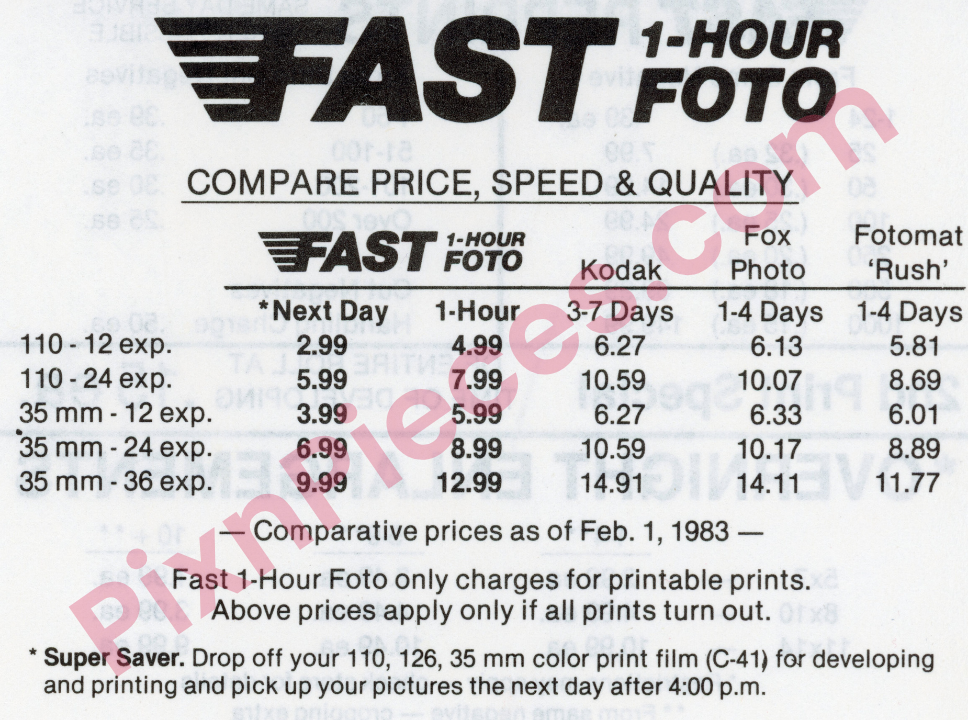
Let’s assume you had one roll of 24 exposure 35 mm film that you wanted to develop. This price list shows it’s $6.99 for standard prints. We also need to factor in the cost of purchased the roll of film in the first place. A quick Google search showed the average cost to buy a roll of a 24-exposure of Kodak 35mm film in 1983 was $2.99.
So, assuming we didn’t want to add an extras like 1-hour service or double prints, we’re looking at a combined total of $9.98 for 24 photos. So I got curious and entered that into the Consumer Price Index Inflation Calculator to get the equivalent in today’s dollars. A 1983 cost of $9.98 is the equivalent of $34.04 in 2026, which calculates to $1.42 per photo!
This is where the math gets really bananas:
It’s estimated that in 2025, the average American took 20 digital photos per day, or 7,300 photos per year.
So at $1.42 per photo, the average American would need to spend $10,366 in ONE YEAR on their photos if we still lived in an analog world.
Obviously, $10,366 is insane, and we only take 7,300 photos now because it’s so easy to do. And a big percentage of those 7,300 are screenshots, duplicates, or not print-worthy.
So let’s be reasonable and say only 10% of your photos are keepers — the ones you’d pay to develop prints of back in 1983. That would calculate to 730 important photos this year – that’s a more reasonable 2 per day or 14 per week. That’s still $1,036.60 per year you’d be spending on analog photos – not including albums, photo frames, or scrapbooking supplies.
For far less than the 1983 analog investments, you can invest in one of these modern ways to protect your digital photos:
-
A high-quality solid state (SSD) external hard drive (less than $200) with enough space to hold your entire collection.
-
A subscription to Apple One Premier is $40/month ($480/year) and you get 2TB of iCloud storage to share with up to five other people. PLUS you also get access to AppleTV, Apple Music, Apple Fitness+, Apple Arcade, and Apple News+.
-
Forever Permanent Storage is only $179 for 10GB and holds 1,500 - 5,000 photos. Forever is where I store my own family’s memories, and I loved it so much that I became an Ambassador for the company. It’s a user-friendly comprehensive photo organizing app, but what I really like about it is that you can purchase your storage once and you own it permanently – no monthly fees or “rented” space. Buy Forever storage today, and your grandkids will be able to access your photos decades from now.
We certainly didn’t expect our photos to be free back in the analog days, and we shouldn’t expect that now in the modern digital age. In fact, by any measure, digital photos are much less expensive to save, organize, and share than our old analog photos were in the past.
Whether you increase your iCloud storage for a couple of extra bucks a month or invest in a premium photo storage app like Forever, your memories will be better protected. Just like the land under your house, the storage under your memories isn’t the exciting part — but it’s the part that keeps everything else standing.